


ACT
01 | Stone 石 — 闻风
A long drone sets the galactic scene of revolving celestial bodies in the cosmos.
—
5 musicians in strategic points sway in tandem with 2 orbiting dancers.
—
The dance of the heavenly stars are locked in constant collision and rebirth.
02 | Earth 土 — 催唢
A lone Suona paces the earth and pleads for new growth.
—
Pulsating Hide hastens the heartbeats of buried seeds.
—
Finally ferocious birth busts out of the sonic terrain.
03 | Metal 金 — 鸣金
Quiet Winds from four corners foreshadow the stealthy arrival of two 天狗 (celestial hounds).
—
Surprised by each other, hounds clash with might.
—
Celestial combat always brings on a molten sonic war.
04 | Silk 丝 — 回荡
The desolate cries of a solo 管子 (double reed pipe).
—
A lost soul in the city full of hidden threats.
—
4 stalking percussionists play up the imminent tension.
05 | Wood 木 — 敲木
The assembly calls of the 八卦 (eight trigrams) by earnest temple blocks.
—
A game of destiny is played with deconstructed Trigrams and numbers at odds with each other.
—
Sustained tones and dissonance with time juggling 9 to 6 to 8.
—
Behold! A vertical sonic Temple emerges.
06 | Gourd 匏 — 击掌
It's not Conference of the Birds but of Misfits.
—
All speaking in different tongues and yet in sync with each other.
—
Crossing paths and heading to their own destinations.
—
The one with the cage is searching for the lost voice.
—
Eternal running and chasing in the cosmos of 八卦.
07 | Hide 革 — 破革
Imagine the full assembly of the Immortal Eight.
—
Each arrives wielding their own mighty magic vessel and pledge their allegiance.
—
In unity, vibrating membranes pierce beyond skin-deep.
08 | Bamboo 竹 — 迎宾
The humble bamboo flute heralds a finale of a different kind.
—
Gathering voices in the auditorium into a song with no word and few notes.
—
When sharing time is that simple and heartwarming,
Our one-voice chorus is just as mighty as the magic vessels of the Immortal Eight.

Organised by
.png)
Reverberance is an award-winning Chinese Wind-Percussion ensemble dedicated to the preservation and evolution of traditional Chinese music. As a champion of the Singapore Chinese Music Competition (SCMC) in 2018 and 2020, and a recipient of the prestigious First Prize at the 2025 Llangollen International Musical Eisteddfod, Reverberance bridges the gap between ancient heritage and contemporary performance art. Their ensemble is renowned for its dynamic fusion of percussive mastery and cultural storytelling, bringing a unique sonic banquet to the global stage.


Collaborator

As the longest incorporated contemporary dance company in Singapore since 1994, ARTS FISSION has gathered a diverse and groundbreaking dance-making record. Under the artistic direction of Cultural Medallion Recipient Angela Liong, ARTS FISSION has evolved into a dynamic hybrid that creates dance works relevant to people and everyday life.
The Arts Fission Company Ltd is supported by the National Arts Council under the Major Company Scheme for the period from 1 April 2026 to 31 March 2029.


Words from Director of Performance Concept, Stage Directions and Set Design,
Angela Liong
THE SYMBOLIC OCTAGON
My proposal to Reverberance is to apply a contemporary treatment to the age-old wind- percussion (吹打) genre. The creative concept of the collaboration between the wind- percussion ensemble REVERBERANCE and contemporary dance company ARTS FISSION begins with an octagon.
Not only is the octagon one of the contemporary geometric design expressions, it also has deep cultural reference to the Bagua (八卦) that is connected to the Eight Immortals. This creative preference of the octagon enables the dynamic play between contemporary dance and the grassroots origin 吹打 wind-percussion music.
THE CREATIVE POTENTIAL OF 8
In the performance, the Eight Immortals are not represented by human characters. Rather the attributes of the Eight Immortals are extracted and presented through creative application in music composition and choreographic staging.
The performance comprises 8 acts that feature 8 different types of musical instruments. These musical instruments, for example xun, suona, sheng, cymbal, woodblock or large drums, are inspired by the ancient Bayin Hui (八音会) — an eight-sound music directory with referral to 8 different materials for constructing eight different musical instruments.
But Composer Sulwyn bypassed the direct reference of eight musical instruments made with correlated eight different materials. Instead, he updated the ancient referral of the eight with a few new ones for the aesthetic shaping of his music creations. Hence, Act 1 features the element stone with its solid mass represented by the prolong soundscape of drone over mysterious, mournful and sustained wind notes.
OCTAGON AS MINI COSMOS
The minimalist set design provides a double octagon. The inner octagon serves as performance space while the outer one is marked by musical instruments used in each act. The legend of the Eight Immortals told of each Immortal being endowed with a specific magical vessel known as the Hidden Immortals (暗八仙). These magical vessels are now represented by 8 featured groups of musical instruments used in the performance.
Unlike rural area of yore where 吹打originated and served to mark everyday living events like wedding, funeral, birthday and other celebratory occasions; 8 Immortals Hop presents the 吹打 of today with a cosmopolitan palette of dynamic tempos and sound colours.
The Eight Immortals were everyday heroes turned celestials. These everyday folks are transformed into city people by the musicians and dancers. They all dressed in modern casual garbs who inhabit the mini cosmos inside the octagon/Bagua. Their interactions in the performance are coloured by familiar urban ethics, attitudes, emotions, and humour.
The collaboration with Reverberance and Music Director cum Co-composer, Sulwyn Lok has been fun and stimulating. I certainly hope the audience would be receptive to this contemporary play on the traditional music genre of 吹打.

Words from Music Director and Co-composer, Sulwyn Lok
WHAT CAN CHUIDA MEAN?
Somewhere in the early sketches for this show, one word kept returning to me: catharsis. I had asked myself what 吹打 (Chuīdǎ, Chinese wind-percussion music) means to Singaporeans — and the more useful question turned out to be what it could mean.
We are, on the whole, a reserved people. We hesitate to be loud, to be wrong in public, to be seen trying. We save our unguarded selves for behind a keyboard, preferably anonymous. Chuīdǎ, by contrast, has never known how to whisper. It is forward, unabashed, unafraid to take up space in a village square. That gap — between how we actually are and how this music has always behaved — became the engine of the piece.
There's a specific detail in the Eight Immortals legend that stayed with me while shaping this piece. 八仙过海,各显神通 — the Eight Immortals crossing the sea, each revealing their own particular power. They don't cross together on one vessel. Each finds their own way across, using a power that belongs to no one else. I wanted our eight acts to work the same way — not eight variations on a single sound, but eight distinct powers surfacing one at a time, each act built so the audience leans in, unsure what's about to reveal itself next. That sense of wonder, more than anything, is what shaped this into a show about close listening.
EIGHT MATERIALS, RECONSIDERED
The show's eight acts draw on 八音 (Bā yīn), the ancient classification of Chinese instruments into eight families by the material they're built from: metal, stone, earth, silk, wood, gourd, hide, and bamboo. Rather than illustrate each family literally, I asked what each material felt like, and let that feeling choose its own sound world — sometimes drawing on instruments outside that family's tradition entirely. I go into these choices act by act in the accompanying composer's notes.
A few threads run through all eight: a constant negotiation between structure and instability, a tension between solitary and communal expression, and Singapore itself surfacing again and again — sometimes as a specific culture, sometimes just as a shared, hesitant, hopeful audience.
A SHARED SCORE
A work like this doesn't come from a single starting point. Working closely with Angela, I developed the sonic character and meaning of each act — what new experience we wanted to offer an audience, act by act — through a series of sketches we talked through together. Those sketches carried the main themes of the show: the melodic and rhythmic material, and the direction each act would take.
As co-composers, Dong Heng and I eagerly bounced numerous ideas off each other to realise the work across many aspects of the production. He went straight into the architecture of each act — taking the themes and direction I had set and charted out how each one could unfold both inside and outside of the score, and how the music could be paced and structured to land the way we wanted our audience to experience it. You will encounter one such idea in the third act METAL 金 — 鸣金; without a doubt one star of the act is the set of metallic cymbals and gongs that brings an immensely rich sound that one player cannot achieve if played traditionally; this is the result of collaboration between him and our percussionist Randy Tan. Our challenges were as much technical and logistical problems as artistic ones, and he solved both together. 8 Immortals Hop carries his fingerprints throughout, and it's a richer work for them.
FROM SCORE TO STAGE
The intentions built into these eight acts didn't stay fixed once rehearsals began. Every act arrived with a meaning, but in the room with Angela, that meaning kept finding new shapes — sometimes ones neither of us had written down to start with. There's a kind of rhyme in that, if you think about it: no two Immortals cross the sea by the same means, and here, music and dance made the same crossing by entirely different powers of their own — one shaped in sound, one in bodies — meeting only once they'd both arrived inside the same octagon. What follows, act by act, holds both: where an idea first took root in the score, and what it grew into once it had dancers to carry it.
CLOSING
Chuīdǎ once marked the milestones of village life — weddings, funerals, births. We've long since traded the village square for the city, but I don't think the impulse it served has disappeared. What our Chuīdǎ asks of an audience today is a little different: to slow down enough to actually listen — to let a single drawn-out note or a drone sit with you, rather than reach for the next distraction — and then, when the rhythms build and the drums take over, to let that same guardedness go, if only for a few minutes, and let the body respond the way it wants to.
Composers' Notes - Act by Act
01 | STONE 石 — 闻风
Four wind soloists — two Xūn (埙), a Dīyīn guǎnzǐ (低音管子), and a Shēng (笙) — stand in the octagon like planets in a slow system, while a bowed vibraphone hovers around them like scattered stars, offering only sparse, shimmering notes. Across two unhurried cycles, the soloists trade a long, evolving drone, the sheng always closing each cycle out. It's in the first of these cycles that the sheng slips in the theme from Wordless Song, in disguised form — the same melody that closes the evening in Bamboo, hinted at here before the audience knows to listen for it. It's the stillest act in the show, but also the most cosmic.
02 | EARTH 土 — 催唢
Earth, here, isn't only the material — it's what happens once that material is shaped into an instrument, carried by travelers who each brought their own grief and burden across it. That image first drew the melody toward Hakka folk song: the Hakka, arguably among the most-traveled of peoples, and a substantial part of Singapore's own cultural makeup. But grief carried far enough turns into something else — the same buried weight becomes the pressure a seed needs to break the surface. Through Angela's staging, that's the meaning that now lives inside this act: not only what earth has endured, but what still, remarkably, grows out of it.
A solo Suǒnà (唢呐) and a single drummer carry the entire act. Separately, the Suǒnà is treated less as a ceremonial voice than a weathered human one, playing on an old joke Singaporean Chinese-orchestra musicians grew up with — that the Suǒnà is "the funeral instrument." Its melody is original, written in the spirit of Hakka folk song rather than quoting one directly. Over the deep, grounded pulse of the Jiàn gǔ (建鼓), the act begins as a distant lament before building into something faster and more urgent — drum pulsing harder, suona double-tonguing toward a single piercing note, arriving at 催唢 (cuīsuǒ), the urgent quickening the act has been building toward.
03 | METAL 金 — 鸣金
Night before a battle: the Yún luó (云锣) opens slow and steady while a vibraphone weaves dreamlike lines around it, and two dancers dart through the space like shadows. Strikes on a Chinese cymbal signal the start of an exchange of blows between the stately Dàgǔ (大鼓) and frantic metallic cymbals and gongs. The music intensifies toward its own climax, and collapses — what plays out, on stage, as an all-out sonic war.
But underneath, the musical inspiration runs the other way. 鸣金 (Míngjīn, "sounding the gong") is the old signal for withdrawal, not advance — what looks like combat began, in the score, as retreat. The drum settles into a steady rhythm that isn't calling anyone to fight, but urging withdrawal, unraveling into something fast, chaotic, and virtuosic, with an absurdist energy running underneath the apparent chaos.
04 | SILK 丝 — 回荡
A lone Guǎnzǐ plays a long, stretched solo, fed live into an audio signal chain that begins untouched and gradually echoes and distorts — thus he both shapes and is shaped by his music. Four percussionists relentlessly revolve around the Guǎnzǐ, periodically striking the instruments at the four corners as they pass — a small world turning regardless of what happens at its center. Staged, that revolving takes on a different charge: the same figures who simply mark time can just as easily read as watchful, closing in.
As the Chinese saying goes: 孤芳自赏 (gū fāng zì shǎng); recall the image of a scholar playing Gǔqín (古琴) alone in the woods, admiring their own fragrance in solitude. Musically, that self-containment becomes a literal feedback loop, growing more unstable and entangled the longer it runs — the world doesn't pause for anyone's solitude, it simply continues on, with or without you.
05 | WOOD 木 — 敲木
The act opens on a single sustained note in the Shēng, gradually joined by other wind instruments, each entering with sustained tones and adding dissonance, building a kind of vertical architecture. Underneath, temple blocks lay down an odd, asymmetrical ostinato — awkward to follow at first, until repetition makes its logic legible. The meter deliberately starts in 9, embracing that oddness, before working down through 6 and finally to 8 — a nod to the show's governing number. The musicians play to a click track throughout, an intentional rigidity: wood as beams, as structure stacking on structure, and the choreography becomes a
negotiation with — and eventual inhabiting of — that unfamiliar order.
06 | GOURD 匏 — 击掌
Gourd instruments like the Húlu sī (葫芦丝) and Shēng are built from multiple pipes joined into one system — and that idea becomes the heart of this act. Two marimba players run a carefree but tonally ambiguous ostinato throughout; the Húlu sī introduces a riff, and the Shēng answers — first in a different key, before correcting itself — joined gradually by offstage musicians, kompang players among them, wandering in. It's the most humorous act in the show, and deliberately so — a celebration of misfits finding their way into a shared system that doesn't fully align, but somehow still works. It's one of the most important ideas in the whole piece: that a system doesn't need everyone perfectly in tune to still be, unmistakably, one system.
07 | HIDE 革 — 破革
Pái gǔ (排鼓), Dàgǔ, Xiǎogǔ (小鼓), and kompang carry this entire act — many membranes, many hands, vibrating together. Early in the process, Angela asked what chuīdǎ actually means in a Singaporean context today, and this act offers one possible answer: eight musicians join on kompang in three interlocking parts alongside the Chinese percussion, an explicit, joyful expansion of the hide family beyond a single culture's drumhead. The three-part kompang writing came out of close work with percussionist Randy Tan — Chinese percussionist by background, but who has studied rebana and Malay percussion in earnest for years. It's the loudest act in the show, and the one where wind and percussion are in the most active relationship with each other.
08 | BAMBOO 竹 — 迎宾 (Wordless Song)
The finale begins not with an instrument at all, but with the sound closest to everyone: singing. A simple motif, repeated until it becomes communal rather than solitary — breath turning into shared song. Dízǐ (笛子) and Bāwū (巴乌) carry the bamboo timbre, but everyone, performer and audience alike, gets pulled into this closing tapestry. It's meant as an emotional exhale after everything before it — and if the audience sings along, even a little, it would be the truest ending this piece could have.
Production Team

Artistic Director, Reverberance
Tan Qing Lun
QingLun Tan is an award-winning Dizi musician and the first Singaporean to earn a Ph.D. in Chinese Music Performance from the China Conservatory of Music. He founded the Singapore Dizi Festival and co-founded yIN Harmony, dedicating his career to promoting traditional Chinese music and nurturing Singaporean composers.
Currently, QingLun is Artistic Director of Reverberance Ltd. and lecturer at Singapore Raffles Music College. He also contributes actively to the arts community as Council Member of the Singapore Chinese Music Federation, Secretary of the Singapore Dizi Society, and Vice-President of the Impression of Nanyang Arts Association.


Music Director, Co-composer, 8 Immortals Hop
Sulwyn Lok
Sulwyn Lok is a composer and music director, between Singapore and New York, whose music has been described as "magical" and full of "beautiful sounds to savour" (The Straits Times). Working across orchestral and Chinese-instrument worlds, Sulwyn writes music that searches for the connections holding us together across cultures and distances.
Sulwyn has received commissions from the arts councils of New York and Singapore, the Singapore Symphony Orchestra, and the Singapore Chinese Orchestra. As music director and composer, Sulwyn co-conceived Harmonies Across the Seas, the closing gala of the 2025 Singapore Chinese Music Festival and the Singapore Ruan Ensemble's 20th anniversary. Inspired by works from the Asian Civilisations Museum, the production gathered soloists from Singapore and China — bansuri, ruan, yangqin, Malay percussion, accordion, and voice — and wove them together with a large ruan ensemble, narration, and live projection, drawing the traditions into conversation with one another.
Beyond the concert hall, Sulwyn's scores have appeared at the Cannes, Busan, and New York Asian film festivals, including the feature We Can Save the World!!!, opened a Hermès exhibition with live performance, and featured across Tencent's documentary Breakfast in China, seen by hundreds of millions. In 2026, Sulwyn is a featured composer at China's Dunhuang Cup.
An advocate for inclusive music-making, Sulwyn works regularly with The Purple Symphony, Singapore's largest inclusive orchestra. Sulwyn is Resident Composer of the Singapore Ruan Ensemble and Reverberance, and Music Producer at The TENG Company. Sulwyn holds a Master's in Screen Scoring from New York University, supported by IMDA's Singapore Digital Scholarship, and was valedictorian at the YST Conservatory of Music.


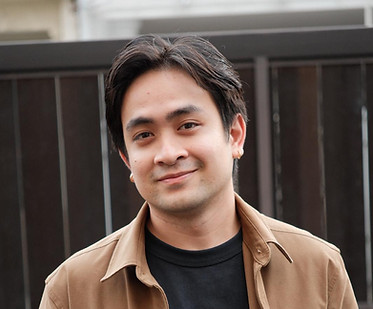
Choreographer, 8 Immortals Hop
Marveen Ely Malate Lozano
Marveen is from Iloilo City, Philippines. He graduated with a Diploma in Creative and Performing Musical Arts (Major in Dance) from the University of the Philippines Diliman in 2019. Trained in ballet, modern, ballroom, jazz, and contemporary dance, Marveen developed a strong and versatile movement foundation. As a company member of the University of the Philippines Dance Company for six years, he built an exemplary performance record on both local and international stages, including appearances in Thailand, Malaysia, and Macau.
In 2018, Marveen won 2nd Prize in the Cultural Center of the Philippines Ballet Competition (Senior Category).
He played the lead role of Jim in SOLO, a film by Kevin Pison that won Best Film at the 4th Quisumbing-Escandor Film Festival for Health and the FAMAS Best Short Film Award (2021). His performance earned him the Best Actor award at the 2021 Singapore International Short Film Festival.
Marveen is also an avid photographer and continues to express this creative visual strand through the camera lens. His diverse working experience in both creative and commercial industries has enriched his craft and shaped him into a versatile and imaginative movement artist.
Marveen joined ARTS FISSION in 2022 and is now the Senior Dancer and Assistant Choreographer of the company. The creative dance works at ARTS FISSION has enabled him to evolve into a captivating performer, taking key solo roles in many of the company’s major productions.

Lighting Designer, 8 Immortals Hop
Aaron Yap
Multi-discipline designer for theatre, ranging from set, costume, lighting and multimedia design, and has undertaken productions of different genres, including Chinese opera, ballet, dance drama, plays and musicals. Keen eye for detail, and having worked in different creative roles allows efficient
communication with other designers, and incorporating ideas from other disciplines into work.


Director of Performance Concept,
Stage Directions and Set Design, 8 Immortals Hop
Angela Liong
Cultural Medallion Recipient Angela Liong is one of Singapore’s most influential dance-makers, with a career spanning over 35 years dedicated to reflecting the complex sensibilities of contemporary Asia and everyday experiences. As the Co-founder and Artistic Director of ARTS FISSION, she has innovated a dynamic dance hybrid approach that extracts the rawness of life through the application of cross-disciplinary methodology.
Angela is a pioneer of site-specific dance in Singapore, using her unique vision to reclaim and transform public spaces. Her celebrated site-specific works have taken place everywhere from the grand staircase of the former Supreme Court, to the historic Cavanagh Bridge, and her works at ARTS FISSION have been presented internationally in Copenhagen, Hamburg, and Melbourne.
An educator who founded the first dance diploma at NAFA and served as Dean of Performing Arts at LASALLE, Angela also believes deeply in the arts' power for social good. This commitment led to the creation of Everyday Waltzes for Active Ageing® in 2009 — a creative movement intervention recognised as an exceptional contribution to the field of active ageing and wellness.
Angela continues to lead ARTS FISSION in creating compelling, contemporary works, including recent cinematic successes like Imagine Ocean (le FIFA 2024), establishing her as a vital voice in modern Asian performance-making.


Co-composer, 8 Immortals Hop
Qian Dong Heng
Qian Dong Heng's works draw on personal experience to create music that moves fluidly across musical cultures and genres, shaped by his regular performances with the Chinese Orchestra and Javanese Gamelan. His chamber works “Four Gamelan Pieces for Yangqin Quartet” and “Blooming Flowers · Fooling Moon”, alongside Chinese orchestral works “The Sky of the Sea”, “Dreams of Night Sky”, and “Sea of Dreams”, have been performed in Singapore, the United Kingdom, and South Korea.

Sound Engineer, 8 Immortals Hop
Melvyn Ng
"Designing stories through sound — The Unseen Musician Behind Every Performance."
Believing that sound is a powerful medium for storytelling, Melvyn approaches every production with the conviction that the sound engineer is the unseen musician behind every performance, shaping emotion, and the space, while engineering meaningful connections between performers and audiences. His work is driven not only by technical precision, but also by musicality, empathy, and collaboration.
His musical journey began in his secondary school's harmonica orchestra before expanding into contemporary bands, giving him a unique perspective that bridges both performer and engineer. Drawing from these experiences, he creates immersive soundscapes that thoughtfully weave together contemporary and ethnic musical traditions, celebrating Singapore's rich multicultural identity.
Beyond live productions, he also works as a recording and mix engineer at the Singapore Raffles Music College, collaborating closely with a number of Singapore's local artists as their audio engineer and mentoring students. His practice spans both the studio and the stage, and he regularly engineers live sound for performances at various venues across Singapore and concerts, bringing the same attention to detail and artistic sensitivity to every project.
"The most magical moments in the arts are often created by the work no one sees. I aspire to transform countless unseen details into extraordinary magical experiences that leave lasting memories for every performer and audience member."
- Melvyn Ng
The Cast
Musicians
-
Chen Kangren
-
Goh Wei Hong
-
Lin Hao
-
Muhammad Afiq Bin Zaini
-
Randy Tan Chen Howe
-
Tan Qing Lun
-
Teiw Hsien Hean
-
Vincent Tan Eng Kiat
Dancers
-
Aisha Josephine Polestico Lozano
-
Andine Elaina
-
Marveen Ely Malate Lozano
-
Sim Yu Xuan Ignatius
Youth Musicians
-
Calix Chua Zheng Xuan
-
Chee Tao Wei, Ernest
-
Daniel Issac Wong
-
Koh Jayna
-
Lau Jing Lun
-
Lim Rui Yang Ryan
-
Neo Rui Zhi
-
Rudy Iman Bin Sa'adon
Board of Directors
(Reverberance)
Chairman
Dato Seri Teo Ngiang Heng, Jackson (BBM, M.ST.J)
Vice Chairman
Mr Ang Chin Koon (BBM, C.ST.J)
Mr Patrick Khoo Hang Choong (BBM, M.ST.J)
Board Members
Mr Goh Gek Liang
Ms Serene Teo Siew Khuan
Dr Lim Soon Hock
Dr Keak Lai Heng (PBM)
Mr Yap Seng Teck (BBM)
Mr Goh Wei Hong
Dr Tan Qing Lun

Post Event Survey
We hope you have enjoyed our performance.
Please help us to improve our future programmes by giving us your valuable
feedback by clicking on through the QR code.
Organised by

Collaborator

Supported by


Official Arts & Culture Media

Reverberance Ltd is an Arts Resident of Singapore Chinese Cultural Centre
